


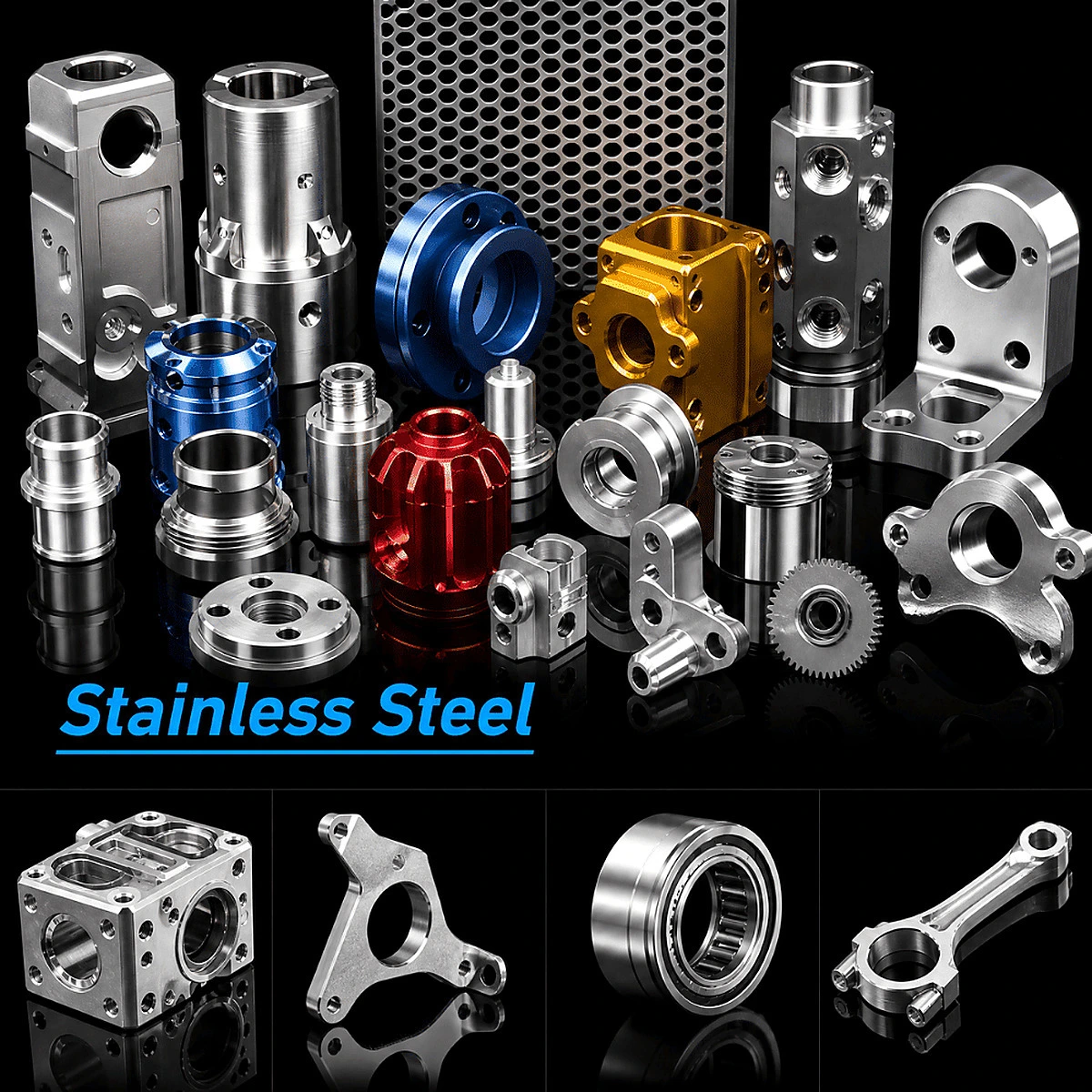
Stainless Steel CNC Machining | Custom Precision Parts
| What we do | What it means for your part | |
|---|---|---|
| 1 | Process route set per grade, not per price | 304 and 316L cut differently; running both on one parameter set guarantees one of them fails |
| 2 | Work-hardening kept under control | The surface hardens as the tool passes, so the pass strategy decides dimensional stability |
| 3 | Stainless-specific tooling and coolant | Stainless galls; general-purpose inserts cannot hold Ra 0.8 repeatably |
| 4 | Passivation and electropolishing | Restores the chromium oxide layer that machining disturbs |
| 5 | Free-iron contamination control | Sharing a line with carbon steel embeds iron that rusts months later |
| 6 | Mill certificates plus CMM | Medical and food customers need traceability, not assurances |
Stainless steel is not "aluminium that is harder". It work-hardens as the tool passes, so a light second pass over a surface that was already cut can be harder than the first; it galls and builds up on the cutting edge; and it conducts heat poorly, so the heat stays at the tip instead of leaving with the chip. Those three facts decide the toolpath, the coolant and the number of passes — which is why a quote for stainless that matches a quote for aluminium is usually a quote that has not been thought about.
What We Machine
| Part family | Visible features | Typical use | What we control | |
|---|---|---|---|---|
| 1 | Valve bodies and manifold blocks | Square billet form, cross-drilled bores, multiple threaded ports, mounting holes | Fluid control, distributors, integrated blocks | Intersection accuracy, port sealing faces |
| 2 | Cylindrical housings and sleeves | OD and bore, milled windows, end-face step | Sensor housings, pump casings, protective sleeves | Thin-wall distortion, window-to-bore concentricity |
| 3 | Multi-port connector blocks | Threaded ports on several faces, internal connections | Air and fluid distribution | Port angle across faces, internal passage clearance |
| 4 | Right-angle brackets | L-shape, large and small hole combination, blended transition | Structural connection, equipment mounting | Squareness of the two datum faces, hole position |
| 5 | Stepped bushings and sleeves | Two-step OD, through bore, chamfered ends | Wear bushings, locating sleeves | Wall uniformity, bore-to-OD concentricity |
| 6 | Flange discs | 4–6 hole bolt circle, centre bore, sealing face | Pipe connections, face-sealed joints | Face flatness, bolt-circle position |
| 7 | Knurled knobs | Straight or diamond knurl, internal thread, step | Adjustment, locking | Knurl consistency, thread concentricity |
| 8 | Rocker arms and levers | Holes at both ends, weight-saving pocket, asymmetric outline | Transmission, hinging | Centre distance, hole-to-face squareness |
| 9 | Sprockets and toothed discs | Even tooth spacing, centre bore, lightening holes | Transmission, indexing | Tooth profile, cumulative pitch error |
Most of the stainless machined components on this page fail at a port or a bore, not at the outside. A cross-drilled manifold block leaks because two holes did not intersect cleanly; a thin-walled housing distorts because the window was cut before the bore was finished; a bushing seizes because the wall was not uniform. That is why the process route matters more than the machine: sequence decides whether the part holds its shape after the last cut.
Grade Selection
| Grade | Corrosion resistance | Machinability | Strength | Typical use | Machining note |
|---|---|---|---|---|---|
| 303 | Moderate | Best (sulphur-added free cutting) | Medium | Shafts, pins, fittings, volume parts | Contains sulphur; not for aggressive corrosion or welded structures |
| 304 | Good | Moderate, galling-prone | Medium | Food equipment, chemical, general structure | Low speed and heavy depth of cut to stay under the hardened skin |
| 316L | Excellent (molybdenum) | Moderate to poor, gummier | Medium | Medical, marine, pharmaceutical, food | Sharp edges and high-pressure coolant are mandatory |
| 17-4PH | Good | Poor | High, age-hardenable | Pump shafts, valve stems, aerospace | Machine in the solution-treated condition, then age |
| 440C | Moderate | Poor (high carbon) | Very high, hardenable | Bearings, knives, wear parts | Machine annealed; after hardening only grinding |
| 430F | Good | Good (free-cutting ferritic) | Medium-low | Appliances, trim parts | Not for welded pressure parts |
Grade choice is usually decided by the medium, not by the drawing. If the part touches seawater, chlorides or CIP chemicals, 316L is the floor and 304 is a future corrosion claim. If it is a wear part, 17-4PH in the solution-treated condition machines reasonably and hardens afterwards — cutting it in the hardened state is an order of magnitude slower and should be avoided at design stage. And 303 is the honest answer for high-volume parts that never see chlorides: it machines twice as fast as 316L, and paying for 316L "just to be safe" is paying for corrosion resistance the part will never use. The same logic applies across custom stainless steel parts: the cheapest correct grade beats the most expensive safe-looking one.
Where Stainless Fights Back
| Difficulty | Mechanism | Consequence | Our countermeasure |
|---|---|---|---|
| Work hardening | Plastic deformation hardens the cut surface | Each pass cuts harder material, sizes drift, edges chip | Constant feed, no dwelling on the surface, stepped passes that always cut |
| Built-up edge | Material cold-welds onto the insert | Torn surface, Ra deteriorates | Sharp edges, high-pressure coolant, coated inserts |
| Poor heat conduction | Heat concentrates at the tip | Short tool life, thermal distortion | Flood coolant, lower cutting speed, higher feed |
| Stringy chips | Tough material will not break the chip | Scratches on finished faces | Chipbreaker geometry, programmed chip breaks, high-pressure coolant |
| Thin-wall deflection | Radial force pushes the wall away | Uneven wall, poor roundness | Segmented cutting, internal support, finish the wall last |
The single most expensive mistake in 304 stainless steel machining is a programmer who "takes it easy" with light passes. Light passes on a work-hardened surface do not remove the hardened layer, they ride on it, and the next pass cuts the hardened skin instead of the base metal. The counter-intuitive rule is the opposite of aluminium: keep the feed up, keep the tool engaged, and never let the insert rub. When a customer tells us the previous shop "kept breaking tools on stainless", this is almost always the reason.
Capability & Specifications
| Item | Typical range | Tight (on review) | Note |
|---|---|---|---|
| Maximum part size | 500 × 400 × 300 mm | 700 × 500 × 400 mm | Depends on part shape and workholding |
| Linear tolerance | ±0.02 mm | ±0.01 mm | Finish milling or turning with multiple flips |
| Roundness / concentricity | 0.015 mm | 0.008 mm | One setup or mandrel location |
| Hole position | Ø0.05 mm | Ø0.02 mm | Multi-face hole patterns in one setup |
| Surface roughness Ra | 1.6 μm | 0.8 μm (0.4 μm locally) | Finish milling, turning, lapping |
| Minimum wall | 1.0 mm | 0.6 mm | Thin walls need internal support or filling |
| Threads | M2 – M30, internal and external | Pipe threads, milled threads | 100% go/no-go gauge check |
| Minimum hole | Ø1.0 mm | Ø0.6 mm | Depth-to-diameter above 5 needs step drilling |
| Process coverage | Milling, turning, multi-axis, drilling and tapping | Turn-mill | Stainless steel cnc milling is a core operation |
| Finishing | Passivation, electropolishing, bead blasting, nickel plating | Local masking, two-tone | Medical parts to customer standard |
| Batch size | 1 – 5,000 pcs | — | Sample orders from one piece |
| Lead time | Sample 7–10 days / production 15–20 days | Expedite on request | Confirmed against the schedule |
The stainless steel cnc milling numbers that matter most are the two small ones: minimum wall and minimum hole. Thin stainless walls deflect rather than bend, so the part looks right on the machine and springs back when unclamped. Small deep holes in 316L work-harden at the drill tip, so a peck cycle that worked in aluminium will burn a drill in stainless. Both are decided at quotation — we will tell you if the design is asking for a feature we can only hold by adding a process step.
Passivation and Finishing
| Process | Purpose | Applicable grades | Effect on dimensions | Note |
|---|---|---|---|---|
| Passivation | Removes free iron, restores the chromium oxide layer | 303 / 304 / 316L / 17-4PH | Essentially none | To ASTM A967 or customer standard |
| Electropolishing | Lowers Ra, improves cleanliness | 304 / 316L | Removes 0.005–0.02 mm | Medical, pharmaceutical, UHV |
| Bead blasting | Uniform matte, removes tool marks | All | Minimal | Slightly reduces corrosion resistance; re-passivate after |
| Electroless nickel | Wear resistance, uniform coverage | Stainless (optional) | Adds 0.005–0.025 mm | Mask threads and fits |
| Anodizing | Not applicable to stainless | Aluminium only | — | The coloured parts in the photo are anodized aluminium |
Passivation is the step buyers most often omit and most often regret. Machining embeds free iron from tooling into the surface; it is invisible, and it is exactly where pitting corrosion starts six months later in a marine or CIP environment. For passivation stainless steel parts we work to ASTM A967 and state the test method on the certificate, because "we dipped it in acid" is not a specification. If your part is for a cleanroom or a pharmaceutical line, electropolishing does more than passivation: it removes the disturbed layer as well as the free iron.
Contamination Control
| Risk | Source | Consequence | Control |
|---|---|---|---|
| Embedded free iron | Grinding wheels, wire brushes, benches shared with carbon steel | Pitting and rust spots | Dedicated stainless tools and area |
| Mixed material | 304 and 316L look identical | Corrosion resistance below spec | Spectroscopic sorting at goods-in plus batch marking |
| Coolant crossover | Shared coolant with carbon steel | Bacteria growth, surface staining | Separate sumps or full changeover |
| Packaging contamination | Wooden pallets, plain cartons | Moisture-driven staining | VCI paper, desiccant, individual packing |
Two stainless parts can look identical and behave completely differently, which is why we spectroscopically check incoming bar rather than trusting the label. The other half is tooling hygiene: a wire brush that touched carbon steel will leave free iron on a 316L surface, and no amount of passivation will fully undo it. For food grade stainless steel parts this is not a cosmetic issue — it is the difference between passing a hygiene audit and failing one.
Inspection & Traceability
| Stage | Method | Output |
|---|---|---|
| Incoming material | Mill certificate plus spectroscopic sorting (304 vs 316L) | Material certificate and sorting record |
| First article | Full CMM report, profile check, go/no-go thread gauges | FAI report |
| In-process | Critical-dimension patrol, tool-life records | Patrol record |
| Surface | Profilometer, post-passivation visual or blue-spot test as required | Finishing record |
| Final | 100% check on critical dimensions, burr and appearance | Inspection record |
| Shipping | Sampling, photo archive, rust-preventive packing | Pre-shipment report |
For stainless we add two checks that aluminium never needs: grade verification on incoming bar, and a post-passivation check when the customer's standard calls for it. Everything else follows the same discipline — CMM for position and profile, profilometer for sealing faces, go/no-go on every thread. The point is not paperwork; it is that when a part fails in the field, the certificate tells you which heat of material it came from.
Applications
| Industry | Typical parts | What matters |
|---|---|---|
| Food and beverage equipment | Valve bodies, fittings, filling parts, screen plates | Food-grade material, passivation, no crevices |
| Medical devices | Instrument handles, housings, connectors, insertion tooling | Electropolishing, cleanliness, traceability |
| Marine and shipbuilding | Deck fittings, pump housings, connectors | 316L grade, pitting resistance |
| Chemical and pharmaceutical | Valve blocks, pipe fittings, reactor ancillaries | Corrosion grade, CIP compatibility |
| Semiconductor and vacuum | Chamber parts, flanges, gas fittings | Low outgassing, electropolishing, clean packing |
| General industrial | Brackets, bushings, levers | Strength, lead time, cost |
How a Custom Order Runs
| Step | You provide | We deliver | Time |
|---|---|---|---|
| 1 Enquiry | 2D/3D drawing, grade, quantity, surface requirement | Grade feasibility and process judgement | 1 working day |
| 2 DFM review | Confirmation of datum, tolerance, passivation standard | Cost-reduction notes: grade change, relax non-critical tolerances | 1–2 working days |
| 3 Quotation | Confirmed batch and lead time | Formal quotation including finishing and inspection | 1 working day |
| 4 Sampling | Sample order | Sample plus FAI and material certificate | 7–10 days |
| 5 Production | Sample approval | Batch, final inspection, rust-preventive packing | 15–20 days |
When you send custom stainless steel parts for quotation, the two lines that change the price most are the grade and the surface callout. "316L, passivated per ASTM A967" and "stainless, please finish" are not the same order — the second one comes back with questions, and the questions are the value. If the part is for a regulated line, tell us the standard at enquiry stage; retrofitting a qualification document after the parts are made is the slowest path there is.
FAQ
Why is stainless steel machining more expensive than aluminium? Three reasons: it cuts at roughly one third to one half the speed, tools wear faster because the material work-hardens and galls, and it usually needs a post-process such as passivation. The material cost is only a small part of the difference. If a quote for stainless matches an aluminium quote exactly, ask what was left out.
304 or 316L — can I just use 304 to save money? If the part never touches chlorides, seawater or aggressive cleaning chemicals, 304 is usually correct and 303 may be even better for volume. If it does, 304 will pit and the saving turns into a warranty claim. Send the medium and the cleaning regime, not just the drawing; that information decides the grade more than the geometry does.
Will passivation change my dimensions? No, passivation removes free iron from the surface, it does not remove metal. Electropolishing does remove material, typically 0.005–0.02 mm per surface, so tight bores and threads need masking or a pre-polish allowance. We decide that at quotation, not after the parts come out of the tank.
Can you machine 17-4PH after heat treatment? We can, but it is slow and expensive. The practical route is to machine in the solution-treated condition (roughly 30 HRC) and age afterwards; the shrinkage from ageing is predictable and can be compensated in the program. If your drawing specifies the finished hardness, tell us — cutting hardened 17-4PH is a different cost structure entirely.
Do the coloured parts in the photo come in stainless too? No. The blue, gold and red components are anodized aluminium — anodizing is an aluminium process and does not apply to stainless steel. They are shown because the same shop runs both material lines. If you need colour on a stainless part, the options are painting, PVD coating or nickel plating, and each has a different wear story.
What do you need to quote a stainless part? A drawing with grade, tolerance, surface finish and the passivation or cleanliness standard, plus quantity and whether the part is for a regulated industry. A 3D model alone is not enough because it carries no tolerance. Send both and the quote usually returns within one working day.
Request a Quote
Send the drawing with the grade on it. If the grade is still open, send the medium the part will touch and the cleaning chemicals it will see — we will tell you which stainless actually survives that, and which one is being specified out of habit. Our stainless steel CNC machining service is built around material behaviour, because on stainless the process route decides the result far more than the machine does.
This rapid prototyping CNC service produces CNC aluminum stainless steel parts for one-piece development, fit checks, functional testing, design verification and small batches. The image states 5–7 day prototyping, free DFM feedback, one-piece MOQ and 100% QC before shipping. Final grade, finish, tolerance and inspection documents are confirmed per project.