


5 Axis CNC Machining, Custom Precision Milling Parts
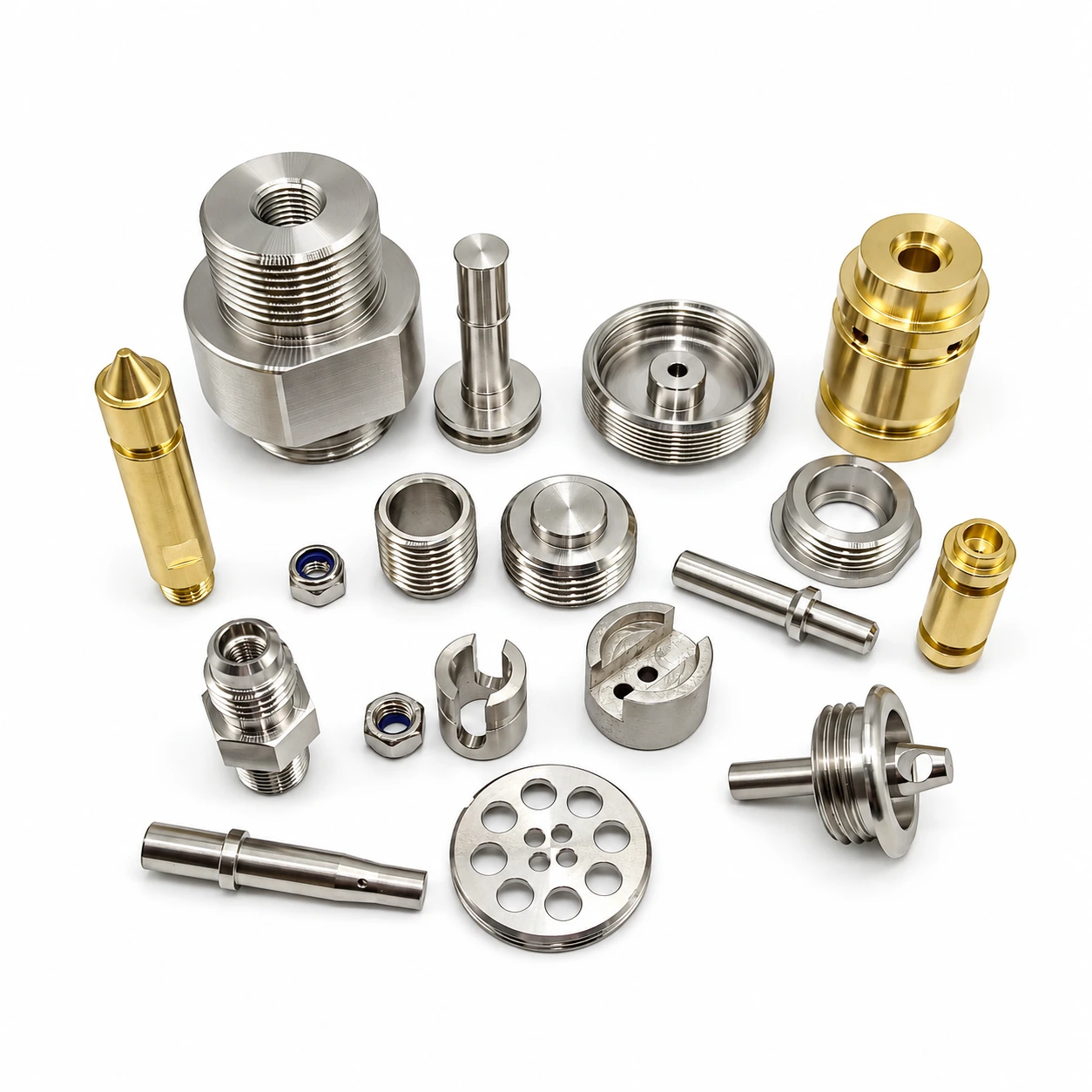
Visible Part Families
| Part family | Features visible or typically defined by drawing | Potential use |
|---|---|---|
| Threaded bodies | External threads, internal threads, shoulders and hex flats | Fittings, adapters and mechanical connections |
| Stepped pins and shafts | Multiple diameters, grooves, end shoulders and small bores | Alignment, motion and positioning |
| Sleeves and bushings | Internal bore, outside diameter and machined end faces | Spacers, guides and rotating interfaces |
| Circular discs | Central bore, concentric steps and face features | Retainers, covers and machine interfaces |
| Flanged parts | Raised flange, bolt holes, counterbores and locating surfaces | Mounting and adapter components |
| Slotted or split parts | Open slot, clamp profile and internal cavity | Clamping, adjustment and fixture parts |
| Multi-hole plates | Patterned holes, central opening and flat faces | Fixtures, mounting plates and brackets |
| Small inserts | Compact body, thread, bore and locating details | Industrial inserts and replacement items |
| Gold-colored turned parts | Cylindrical body, grooves and end features | Fittings or decorative/functional components; material to confirm |
| Custom micro-feature parts | Small holes, narrow grooves and close feature spacing | Instruments, mechanisms and compact equipment |
![5 Axis CNC Machining, Custom Precision Milling Parts 6]() Geometry and Feature Capability
| Feature | Description | Drawing information to provide |
|---|---|---|
| External thread | Threaded outside diameter for connection or adjustment | Standard, nominal size, pitch, length and relief |
| Internal thread | Threaded bore for fasteners or mating components | Thread standard, depth, lead-in and bottom condition |
| Stepped diameter | Multiple coaxial diameters on one component | Diameter sequence, shoulder locations and fit |
| Through bore | Hole passing through the part | Diameter, position, straightness and finish |
| Blind bore | Internal cavity with defined depth | Diameter, depth, bottom form and tool access |
| Radial hole | Cross-hole or side hole in a cylindrical body | Location, angle, diameter and intersection |
| Flange | Wider mounting or locating section | OD, thickness, hole pattern and datum |
| Slot or split | Open relief or clamping feature | Width, depth, length and edge treatment |
| Chamfer | Beveled edge for assembly or deburring | Angle, width and affected edges |
| Counterbore/countersink | Recess for fastener head or seating | Standard, diameter, depth and position |
| Multi-face detail | Features on several sides of a part | Datum scheme, orientation and access requirements |
Material Directions
The image presents silver and gold-colored components but does not identify exact grades. Material selection should be recorded on the drawing or purchase order.
| Material direction | Typical reason to consider it | Example parts |
|---|---|---|
| Aluminum | Low weight and suitability for many machined geometries | Small housings, plates, brackets and inserts |
| Stainless steel | Corrosion resistance and durable exposed surfaces | Threaded bodies, shafts, sleeves and fittings |
| Brass | Machinability, conductivity and distinctive appearance | Small fittings, inserts and turned components |
| Carbon or alloy steel | Strength, rigidity or wear-related requirements | Pins, shafts, clamps and industrial parts |
| Engineering plastic | Lightweight, insulation or low-friction requirements | Bushings, guides and non-conductive inserts |
Process Selection
| Process route | Best suited to | Buyer benefit |
|---|---|---|
| 5 axis CNC machining | Angled faces, compound surfaces and multiple orientations | Reduces repeated setups for complex parts |
| 3 axis or standard milling | Prismatic blocks, faces, pockets and holes | Efficient for simpler milled geometry |
| CNC turning | Coaxial shafts, sleeves, rings and threaded bodies | Efficient for rotational components |
| Turn-mill machining | Rotational body with cross-holes, flats or slots | Combines complementary features |
| Drilling and boring | Through holes, blind holes and precision bores | Supports assembly and fit requirements |
| Threading | Internal or external threads | Creates mechanical connections |
| Deburring and edge finishing | Burr removal and assembly preparation | Improves handling and fit |
| Surface finishing | Appearance, corrosion or functional finish | Aligns the component with the application |
Drawing-to-Part Workflow
| Stage | Work activity | Buyer-facing output |
|---|---|---|
| 1 | Receive drawing, CAD model or sample | Reference information and revision record |
| 2 | Review geometry and critical features | Clarified dimensions and open questions |
| 3 | Select machining route | Turning, milling, 5-axis or combined process proposal |
| 4 | Confirm material and finish | Material grade and surface-treatment record |
| 5 | Prepare quotation | Project-specific pricing and timing discussion |
| 6 | Manufacture prototype or first article | Physical part for fit and function review |
| 7 | Inspect critical features | Dimensional and visual inspection results |
| 8 | Apply approved finish | Surface treatment according to project requirements |
| 9 | Pack and identify parts | Labels, revision and protective packing |
| 10 | Ship and manage repeat revision | Ongoing supply reference for future orders |
Customization Services
| Customization item | Available discussion | Information required |
|---|---|---|
| Geometry | Threads, holes, steps, flanges, slots, clamps and inserts | 2D drawing, 3D CAD or sample |
| Part size | Diameter, length, wall thickness and feature spacing | Fully dimensioned drawing |
| Material | Aluminum, stainless steel, brass, steel or plastic | Grade and use environment |
| Finish | Machined, polished, brushed, anodized, plated or coated | Finish standard or reference sample |
| Tolerance | General and critical dimensional tolerances | Tolerance table and datum scheme |
| Assembly fit | Mating bore, shaft, fastener or housing relationship | Assembly drawing or mating-part data |
| Prototype quantity | One part, small batch or repeat order | Quantity and project stage |
| Marking | Part number, revision, batch code or logo | Artwork and marking location |
| Packaging | Individual protection, trays, bags and labels | Packing instructions |
| Repeat manufacturing | Revision control and inspection plan | Forecast, order frequency and approved file |
Applications
| Application area | Example parts | Relevant project focus |
|---|---|---|
| Automation equipment | Pins, inserts, brackets, clamps and adapters | Alignment, repeatability and assembly |
| Industrial machinery | Shafts, sleeves, flanges, housings and threaded bodies | Load, fit and serviceability |
| Instruments and sensors | Small housings, rings, threaded fittings and inserts | Compact geometry and interface accuracy |
| Robotics | Joint parts, spacers, adapters and small structural components | Motion, weight and connection |
| Electronics equipment | Mounting blocks, housings, plates and heat-related parts | Interface, insulation and appearance |
| Repair and maintenance | Replacement pins, sleeves, fittings and custom adapters | Sample matching and revision control |
| Product development | Prototype milling parts and design-validation components | Fast iteration and fit testing |
| Fixtures and tooling | Clamps, locating parts, inserts and mounting elements | Repeatable positioning and durability |
Quality Information
| Quality item | What should be defined | Why it matters |
|---|---|---|
| Drawing revision | Approved file name and revision | Prevents outdated production data |
| Datum scheme | Primary, secondary and tertiary references | Aligns inspection with function |
| Critical dimensions | Fit, sealing, movement and mounting dimensions | Directs inspection effort |
| Thread verification | Thread form, gauge or mating-part requirement | Reduces assembly risk |
| Bore and shaft fit | Clearance, transition or interference relationship | Supports predictable installation |
| Surface finish | Roughness, appearance or treatment requirement | Matches function and visual expectation |
| First article | Prototype or first-piece review | Confirms design before repeat work |
| Packing identification | Part number, revision and batch label | Supports traceability |
FAQ
Q1. What are custom precision milling parts?
Custom precision milling parts are non-standard components manufactured from a drawing, CAD model or approved sample. They can include small housings, inserts, brackets, flanges, plates, clamps, threaded bodies and multi-face metal parts.
Q2. When is 5 axis CNC machining useful?
5 axis CNC machining is useful when a component has angled faces, compound surfaces, features on multiple sides or limited access for standard setups. The actual machine route should be confirmed after reviewing the geometry.
Q3. Can you produce small aluminum CNC machined parts?
Small aluminum CNC machined parts can be reviewed according to the drawing, material grade, wall thickness, feature size, tolerance and quantity. The final feasibility depends on the part design and selected process.
Q4. Can you machine stainless steel as well as aluminum?
Yes. Aluminum and stainless steel are both within the stated material direction. Exact grades, heat condition, finish and inspection requirements should be listed on the drawing or purchase specification.
Q5. Do you support both milling and turning?
Yes. Milling is suitable for faces, pockets, slots, holes and irregular profiles. Turning is suitable for coaxial shafts, sleeves, rings and threaded cylindrical bodies. A combined route can be considered for parts with both feature groups.
Q6. Can the parts be made from one sample?
A sample can support a project review, especially for replacement or reverse-engineering work. For accurate repeat production, a 2D drawing or 3D CAD file with material and tolerance information is preferred.
Our custom CNC machined metal parts can be developed from drawings, CAD files or samples. The CNC machining service for aluminum and stainless steel supports housings, fittings, shafts and assembly hardware. Custom CNC turning and milling parts can combine rotational features with holes, flats, pockets, slots and mounting faces. Final material grades, tolerances, finishes and inspection requirements are confirmed per project.
Our service produces anodized aluminum CNC parts and CNC machining prototype parts, plus stainless steel parts, CNC turning, milling and Swiss-type machining. The images show drawing review, raw-material procurement, FAI, machining, IPQC, dimensional inspection, batch inspection, surface treatment, final inspection and delivery. Exact grades, tolerances, finishes and schedules are confirmed per project.